
Dancing Through Silent Hill
“in my restless dreams”
It’s 2001 and I’m watching a man play Silent Hill 2.
It’s 2019 and I’m performing a sword dance to Silent Hill music.
It’s 2020 and I’m watching a different man play Silent Hill 2.
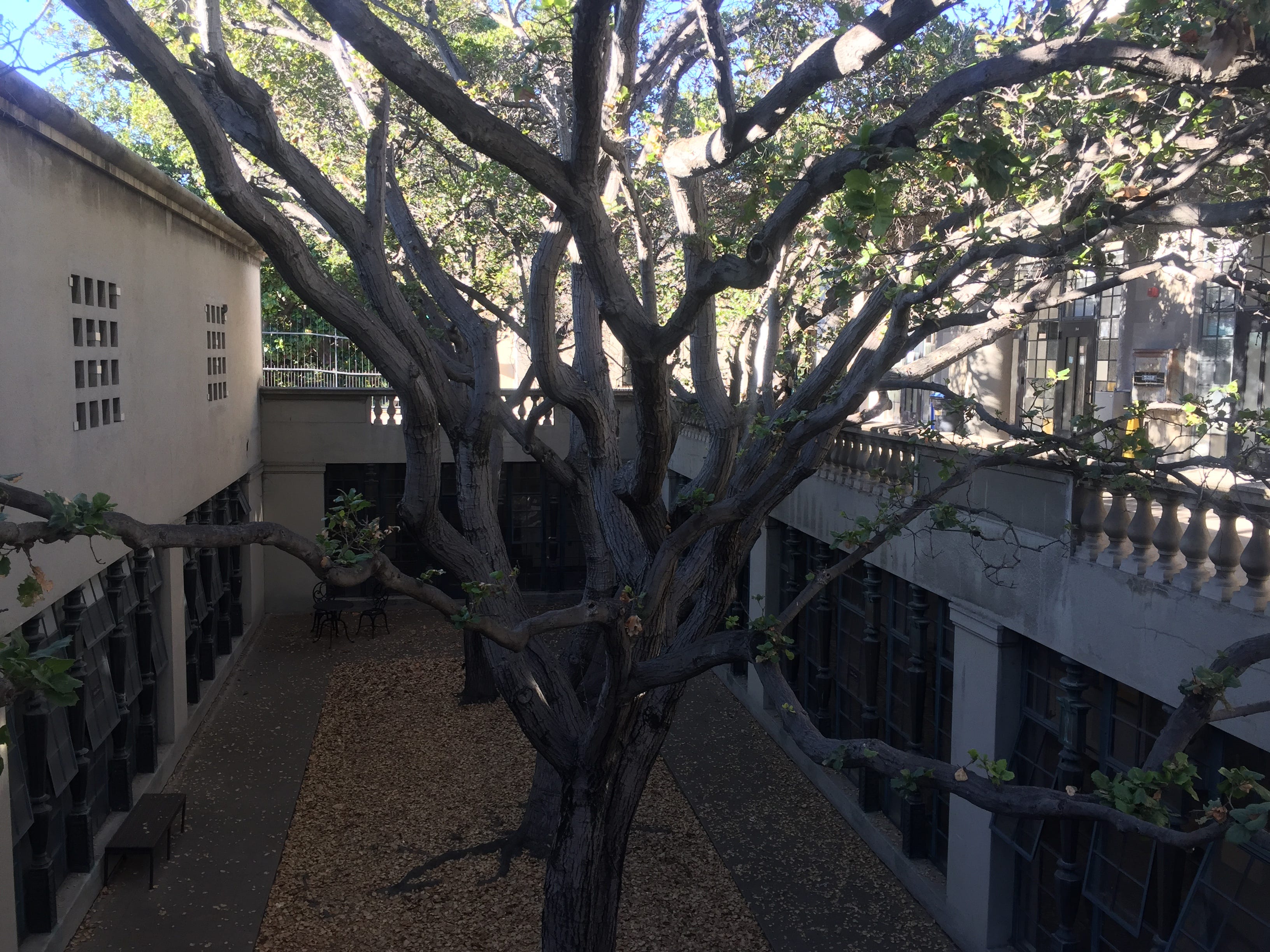
In 2019, I rehearsed and performed my Silent Hill dance piece—belly dance with a scimitar—at U.C. Berkeley’s Hearst Gym, formerly known as the Hearst Gymnastium for Women, as lettering that remains on the building informs you. While waiting for my reserved studio time to arrive, I would snack on the east patio: an enclosed courtyard with trees centered between chairs along the walls: a carefully constructed bower. The gym is known for its enclosed pool: its walls, adorned with protective Greek statues, kept women from receiving unwanted gazes while giving their gazes to the Campanile, the tall phallic tower featured on many Berkeley shirts and totes. The building is also known for its large Grecian urns, the kind that would inspire Keats’ verse. The statues, urns, and balustrades have aged, not quite to the level of those that the protagonist of Clarke’s Piranesi documented, but enough to remind the viewer that the building was constructed about a century ago, in the 1920s.
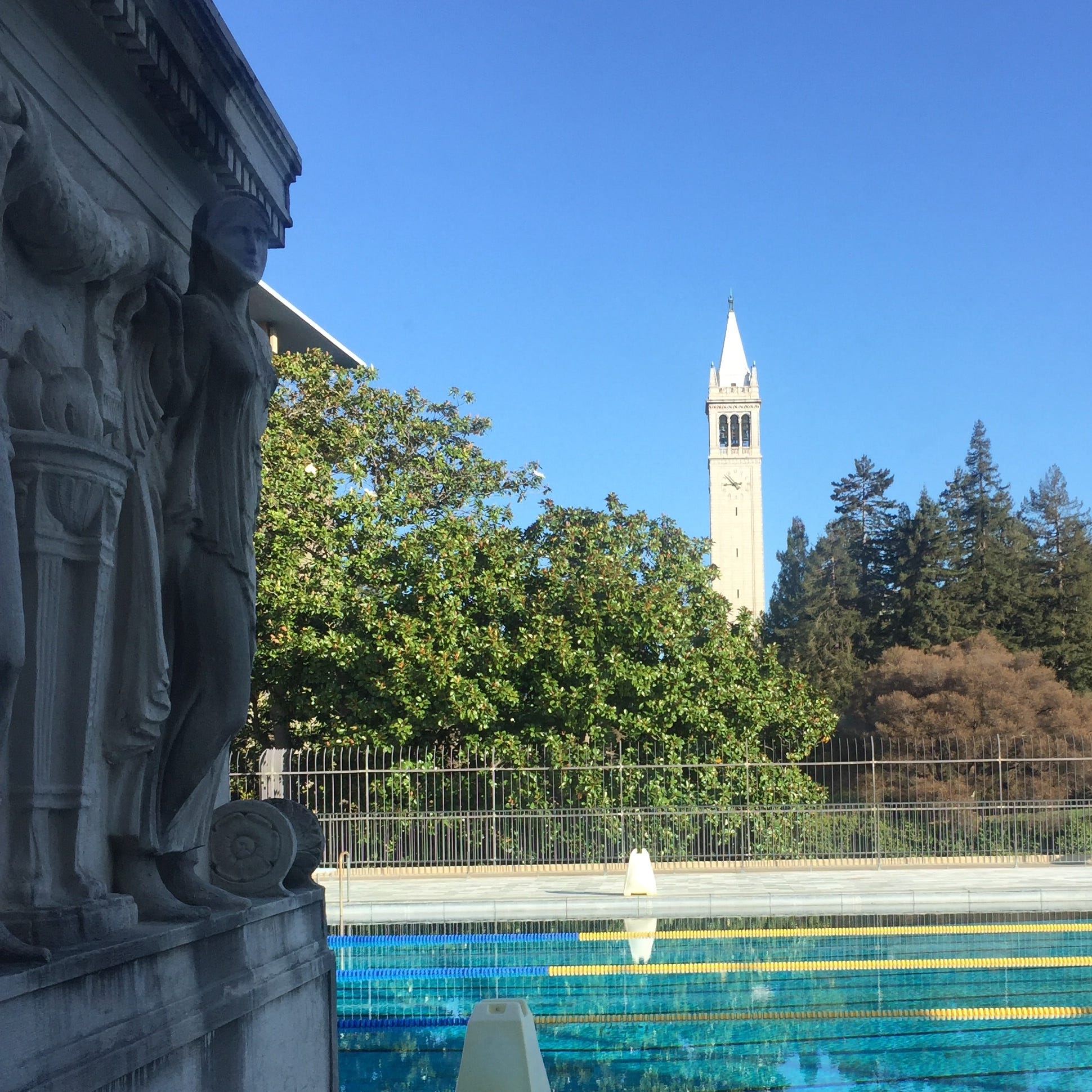
The original structure, Hearst Hall, burned down in 1922: a fire that might vaguely remind you of the fires in Centralia, a real-life version of the smoldering, bloody, misty world of Silent Hill. Hearst Gym was rebuilt in 1927, designed by Bernard Maybeck and Julia Morgan in a Beaux Arts neoclassical style, and sits along Bancroft Way (a block or two down from Eshleman Hall) on the edge of campus, near Caffe Strada. At one point, it contained an indoor rifle range (weapons that you long for when first encountering the monsters in Silent Hill). In 2019, and now, there are several reservable dance studios inside, each with intricately framed windows, their decorative bars enclosing the light. The bars divide the windows into squares that would be too small to escape through if the Silent Hill siren sounded and monsters spawned in these spaces. You would have to break the bars or find another exit.
However, the monsters that did spawn in my dance rehearsals were a distorted reflection of James’s externalizations of his guilt. He struggles with the female form, seen in mannequins and nurses, because of his violence against it: the murder of his wife. I struggled with my body not matching what I saw in my mind, finding errors in my movements when they lost musicality or didn’t flow or put me on the wrong foot. I felt guilty when I dropped my sword on the wooden studio floor (although it didn’t really take any damage). I felt guilty when I transmitted awkwardness into such a beautiful space and hypnotic song. My monster was myself, my flaws mirrored before me, rather than James seeing his violence manifest outside of himself.
So much of rehearsal is failure—you try, you fail, you try again, you try something new, and perhaps you find something better. Then, you fail better when you make mistakes executing the new and improved movement phrase. I gave myself harsher notes than I’d give another dancer. My critical eye harshly commented, but my body never vocalized the criticism; it rattled around in my brain, unstoppable, picking up other mental trash, growing. An echo chamber for one, enclosed in a body held by the studio. One echo: I didn’t have flat splits at the time (like I do now). Only being able to drop into a half split with a sword on my head didn’t impress me; I wanted both legs fully extended, rather than slightly bent. I wanted a better angle (and perhaps an angel of flexibility to bless me).
What keeps you rehearsing is those moments when you find synchronization between the music and the body. It just feels so good to embody music, and it tends to look good too, in part because it feels good. The theme song of Silent Hill permeated my limbs, my hips, my chest. I shimmied in time with the mandolin. I fought monsters and, sometimes, won. Rather than plunging my scimitar into an enemy, I made it my dance partner. Our victory was over rebellious feet and incorrect timing, over undesired hand positions and turning the wrong direction, over forgetting what I had just choreographed.
When I posted some clips from rehearsal (above)—horizontal and vertical figure eights, infinities drawn with my hips, chest circling and body rolling to the strum of a guitar, all while balancing my sword on my head—my friend Kari, a guitar player, shared a link to her published poem about Silent Hill in the comments. We both interpreted enduring and shared media through another form of art. Art spawned more art. The internet gave us a way to share our artistic endeavors. The internet also took away our shared space. The literary magazine that featured Kari’s poem is now defunct. You can only see it on the Wayback Machine now.
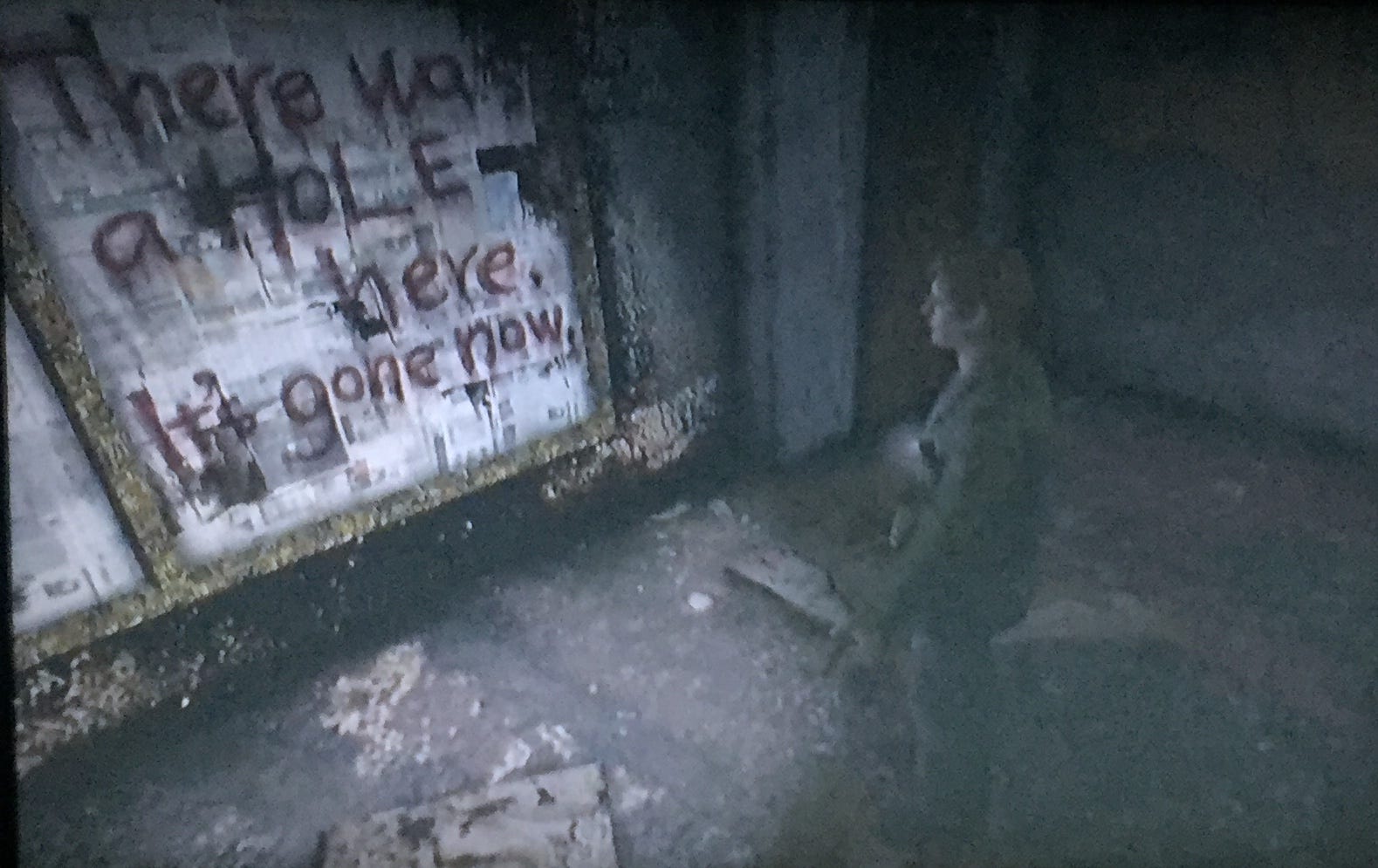
The next year, separated by quarantine in 2020, we had another social media exchange when I posted a picture of my then-boyfriend replaying Silent Hill 2. The magazine was still alive, and Kari was able to share her poetry with another poet friend of mine. The picture (above) featured James looking at writing on a wall that says, “There was a hole here. It’s gone now.” Now, not only is the magazine gone, a hole for storing poetry gone, but even more is lost. In 2022, Kari passed away at a too-young age. I’m haunted by my grief; it is the monster in my restless dreams. While her words on my posts remain, they are messages from a ghost (hers is one of many social media accounts of the dead). She’s gone now. Silent Hill remains.
I keep going back
to that place. But you are gone.
I dance with the mist.