
The Teaching Body
vs. the practicing body
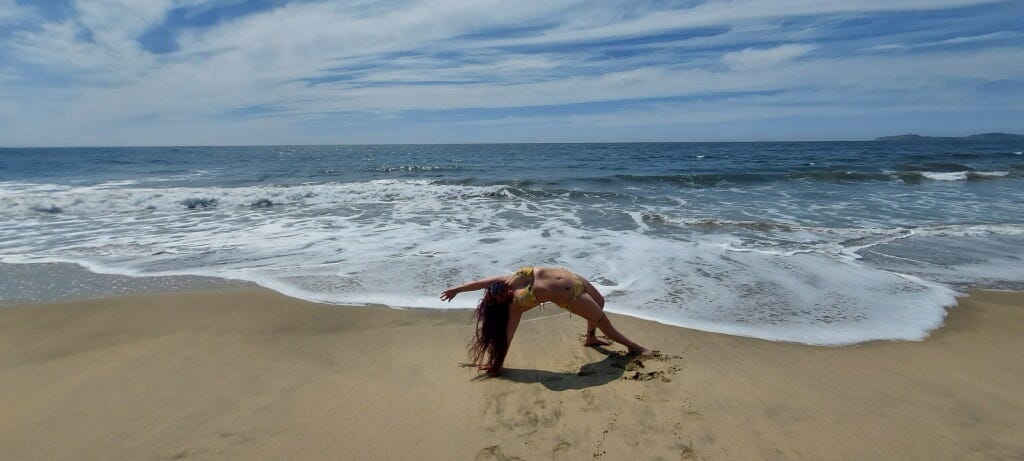
I recently reignited my love of teaching yoga in a weekly night at the museum (where I work) class. It’s been a few years since I’ve cued and demoed yoga asana (with some active flex/PNF elements blended in), or led meditations. In those intervening years, I’ve kept up a personal practice: gotten my bad side (the evil left path) front split flat, maintained upper body strength, and kept my back bendy. But, leading a gentle yoga class exhausted my body in another way.
I worried in my first couple yoga classes that I wasn’t giving my students enough because my personal practice is so much more intense than what my coworkers desire. Do they feel loose and strong? I wondered. Is this—am I—enough today? Is this sequence a good flow? What do they think of this meditation? However, I could feel the work in my body the next day, could identify the muscles that I targeted by their pleasing ache, could feel my mind muscling from leading familiar visualizations. When my students asked for my initial one-off class to become a weekly one, some of my worries ebbed.
In my personal practice, I work towards, and at, my end-range: the furthest I can stretch, the longest I can hold, the smoothest I can transition. I know which positions and techniques are most effective for my body and its quirks. I hang out in my favorite asanas. I integrate pilates. My peak pose is either three splits (hanumanasana) or wheel (chakrasana). I try to remember to train my center splits—my next physical goal—but I sometimes tap out before I get to them, spent from the progressions in my more beloved positions. I use blocks, a foam roller, and sometimes even the pole. While I am on my yoga mat, I look up at the chrome dome that attaches my pole to the ceiling, checking if my back leg is straight in my splits; it’s the only mirror I use in my practice. I feel my way through it most of the time.
Teaching, on the other hand, is not the teacher’s workout. My body is an illustration for others to refer to, a fluid moving between different variations, offering options. I do feel stretching and strength in my body, feel my mind activate, but I also have to find words for what I’m doing. I have to project them while flowing and holding my body in atypical lecturing positions. Solitary practice is a near-silent experience for me, with a few sighs, grunts, and swears, but never sentences. My body speaks to me, when I shut up and listen to it. Teaching is narrating your actions, your breath, your internal vision. Yoga teachers become Ron Howard in Arrested Development, Kristen Bell in Veronica Mars, or Nick Offerman in The Life of Chuck, explaining the plot in great detail.
You have to tell, as well as show, when instructing yoga and other movement classes. You are not following the Iowa school rules of writing; instead, you are ignoring Hemingway, adding adverbs, and leaning into repetition. You don’t try to create beautiful imagery; rather, you try to employ useful metaphors. Language imitates movement, palely follows in its path. The body is the outline, the structure, and the conclusion of class. It tells you what to say; there are myriad ways to articulate, to overexplain, what it’s doing. You are not giving a clever lecture (as I once tried to do in a west coast swing class about the history of the movement style). You are breaking down things that your body has accepted as routine, things that it finds simple. Sometimes the simplest things are the hardest to explain.
When I’m working on a new sequence, I consider the ways to explain what I’m doing—a version of what I learned in a college writing pedagogy class. We were taught to present information in six different ways (the number is somewhat arbitrary, the ability to change how we explain something is the take-away). In yoga, and other movement classes, the body is one way to explain: perhaps the best way for visual learners, or rather visual learning (most people have a mix of learning styles that can shift based on the subject matter). Words are useful when you’re in a position where it’s hard to see the teacher and to explain what to do inside a pose or movement. How to breathe, how to use different limbs, how to situate body parts in relation to one another and the space around them. Words illuminate the workings of the body, and the body translates words into physical reality.
If you enjoy my writing, and are able, please consider leaving a tip here or here